To Unlock Middle Housing, Zoning Reform is Just the Start

Updated: Feb 13

Modifying zoning regulations to permit duplexes, triplexes, and small multifamily "middle-housing" is a crucial initial step in addressing housing affordability challenges and offering more housing options to better meet demand in most areas. However, as demonstrated by real-world examples and recent studies, zoning reforms by themselves will not achieve the necessary scale of middle housing production, akin to the levels of production witnessed in this country decades ago.

A detailed report from the Harvard Joint Center for Housing highlights that, even with land-use reforms in Massachusetts, constructing small multifamily units would still remain difficult due to additional regulatory, design, financing, and other institutional and systemic challenges. In Memphis, officials collaborated with a small developer to remove many of these hidden, non-zoning barriers, paving a smoother path for small middle housing builders in the city.
Building a True “Missing-Middle Ecosystem” in Massachusetts

The final installment of an excellent three-part series from researcher Amy Love Tomasso at the Harvard Joint Center For Housing Studies found the impediments to middle housing production at scale in Massachusetts and made six key recommendations that go beyond just zoning reform, although a key component of unlocking middle housing at scale here.
Key recommendations include;
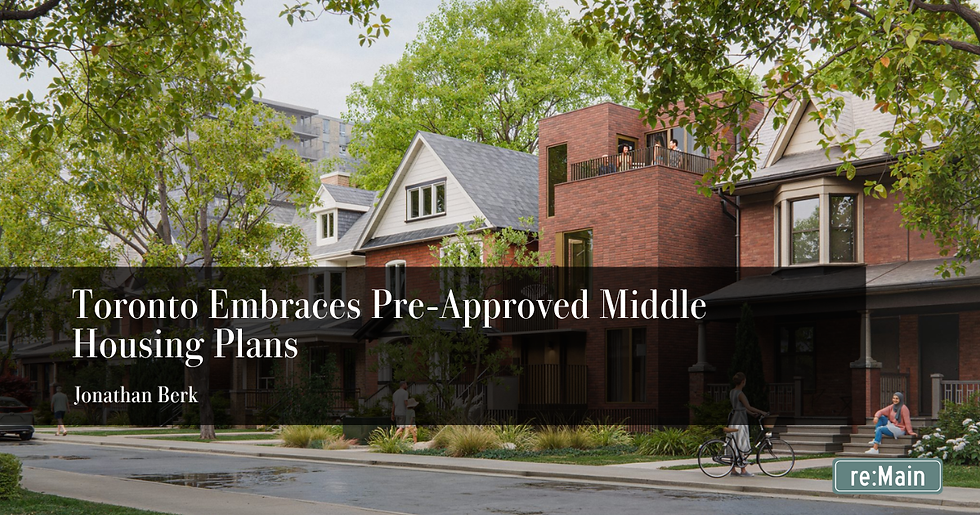
Adopting pre-approved plans. Create a statewide (or regional) design guide for middle-housing, with locally calibrated, pre-approved construction plans. This lowers architectural costs, helps communities visualize how middle housing fits neighborhood character, and speeds up permitting.
We've seen other places like Kalamazoo, South Bend and Kelowna in Western Canada adopt similar programs recently. The State of Vermont is also currently embarking on a similar program.
Grow the builder base. Because decades of restrictive zoning pushed small-scale multifamily out of reach, many communities and regions now lack builders with experience in “gentle density.” JCHS recommends training cohorts and construction-trade pipelines to build that capacity, especially among community-rooted or historically excluded developers. Locally, groups like The Builder Coalition have begun engaging and providing support programs to the burgeoning small developer community in the Greater Boston area.
Pilot middle-housing initiatives in ready communities. Target municipalities that already have supportive zoning, infrastructure, and political will, so early projects can demonstrate viability and build momentum. We've seen a number of communities, from New Bedford to Salem, begin to streamline the processes for small builders and would be excelent candidates for pilot programs showing their willingness to grow the small developer ecosystem. There's obviously more reforms to do but they're communities showing a willingness to embrace new housing production.
Support construction innovation. Encourage modular, panelized, or off-site construction methods, which can reduce costs and make small-scale infill more financially feasible. Massachusetts is a center of innovation and with local startups like Reframe innovating in the modular construction space, we must ensure our systems arent the impediment to their success locally.
Create new funding sources. Traditional lenders often see small-scale multifamily as risky or inefficient. JCHS recommends tools like a middle-housing tax credit, dedicated pre-development loan funds, or expanded eligibility under existing housing-finance initiatives.
Establish a coordinating office or role. A dedicated “Missing Middle” office or division, at the state level, could align zoning, design guidelines, funding, builder training, and community outreach to ensure policies actually result in homes built.
Memphis Learned Alongside Small Builders To Enact Reform's Necessary to Build

The story of Malone Park Commons in Memphis shows what’s possible when a city confronts the full set of barriers and acts to remove them while learning from those doing the work and running into the hurdles on the ground every day.
Building-code reform: Instead of forcing small multifamily buildings into “commercial” code because they’re more than two units (which often triggers expensive commercial-scale requirements), Memphis adopted a local “Large Home” amendment allowing buildings up to six units to be reviewed under a modified residential code. That dramatically lowers costs and complexity for small-scale developments.
Fire-safety & sprinkler reform: Because classic multifamily codes required sprinkler systems and commercial-grade fire safety measures even for modest four-unit buildings, adding tens of thousands per building, Memphis worked to allow proportional, scaled safety standards (e.g. two-hour fire-rated wall separations or simpler sprinkler systems) appropriate for small developments.
Utility reclassification: The local water utility initially treated each fourplex as a commercial property, requiring expensive backflow prevention devices and charging higher rates. After code and policy changes, buildings up to four units now qualify for residential service, saving thousands per unit.
Permitting and approval streamlining: By auditing and reforming the permitting process, Memphis reduced the friction that often kills small-scale development. Projects that once might have been delayed or made financially untenable now have a faster, more predictable path to approval.
If we believe in walkable neighborhoods, housing choice, affordability, and inclusive access, then the goal isn’t just to update our archaic zoning codes. It’s to rebuild the full housing ecosystem so that middle-scale, neighborhood-friendly housing can actually be built.
That means:
Pushing for design guidance, pre-approved plan sets, and builder training, so small, community-rooted developers have what they need to build efficiently.
Supporting modular or off-site construction, and financing tools tailored for modest, infill projects.
Advocating building-code and utility-policy reforms to make sure we're enabling small multifamily infill housing, not punishing small builders, treating them as if they're proposing large a huge apartment block.
Creating or backing a dedicated “Missing Middle” office or coordinator role to shepherd zoning, design, permitting, funding, and community outreach.
Recognizing that incremental, small-scale housing can expand options and affordability without sacrificing neighborhood character — and that this often works best when built by local builders deeply rooted in the community.
The research from the Harvard JCHS and the real-world progress in Memphis together make an important point: legalizing middle housing is just the beginning. Without building code reforms, simplified permitting processes, financing tools, and institutional support for small developers, many middle housing zoning reforms may end up just gathering dust, rather than unlocking real homes. If we want missing-middle housing to become more than a promise, to become real, walkable, human-scaled homes in our towns and cities, we need to do more than change the zoning map. We need to rethink the whole system.
Jonathan Berk is an experienced strategic urbanist, attorney, and policy innovator with over a decade of expertise in promoting reforms in housing, land use, and economic development through impactful public-private initiatives. He possesses deep knowledge of the structural obstacles to housing production and economic growth, such as regulatory hurdles and financing challenges, and has a proven track record of creating collaborative solutions that unlock opportunities and achieve measurable results. He is a skilled communicator, published thought leader, and a trusted advisor to policymakers, planners, and advocates working where policy, capital, and community intersect.


Comments